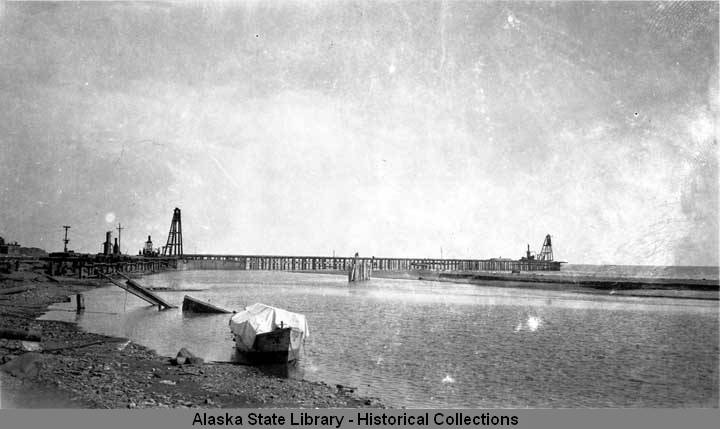
Google, Google, Google… usually so adept at anticipating my needs. Coming of age “rituals” of teens in Alaska? When Nome got electricity? Linguistic features or regional vocabulary? Nada. But if the information isn’t out there, I suppose I can’t blame Google. It would need to be digitalized somehow for Google to find it.
In “When Google Fails (part 1): Go Local” I said I was going to contact a local, and I did. I contacted Diana of The Nome Nugget just a few moments ago, giving her an update on my project, since it has changed radically since I last wrote (originally I was going to write a short picture book about an 8 year old girl, but now I’m up to 7,000 words about a 12 year old). I also asked if she knew of any long time residents of Nome that would be interested in a pen pal. Best case scenario: I get a pen pal who loves history and have a lively correspondence. Worst case? She tells me to get lost. We’ll just have to wait and see!
But I am not waiting around for a pen pal. So where am I getting information from in the meanwhile?
Pictures.
Alaska’s Digital Archive is a treasure trove of information through pictures. The search feature on it is a bit wonky, so the best results are had when searching all databases for “Nome.” It will give you pictures of Nome from 1889 through the 1950s, about 600 total. Maybe there are more recent photos mixed in as well, but I haven’t come across them yet. I spend hours analyzing photos and trying to create a timeline of events.
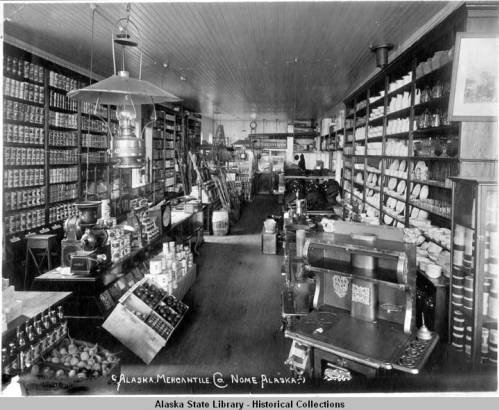
Take this photo as an example. It is a the Alaska Mercantile Co, in Nome from sometime between 1903 and 1907. It may not have existed at the exact time as my story, but it tells me what kinds of things were available, and what the main character’s parents had access to. Dishes, cooking utensils, canned goods, and some limited fresh foods could be bought in town. In the very back of the store seems to be larger/taller gear, and in the front, a wood and coal burning cook range.
Seeing that wood and coal burning cook range made my day. How many people can say that? I was happy because it partially answered a question about how homes were heated. Those stoves were used for cooking and heating. Now, of course, that led to another slew of questions, like, what are all the doors for, and how the h#$$ do you use it?
Ooooooh, I can hear people now. “Make fire. Put pan on top. It’s not that complicated…” Well, I’ve cooked on enough camp fires to know it’s not easy to control a fire’s temperature. Boiling water for mac & cheese, or putting a hotdog on a stick, is just not the same as baking bread or cooking a full breakfast.
I imagine a person would have to build up the fire enough in advance to get the stove top hot. Then depending where the fire is built (bit to the left, bit to the right, back/left..?) there would be a “sweet spot” that cooks best. If you’re cooking multiple things, you’d probably need to rotate pots. If letting a stew cook for half the day you’d probably have to replenish the wood or coal. I’ve never cooked with coal, but for wood, you’d need the right size logs for whatever it is you’re looking. To build a hotter fire, 3-4″ logs, larger for longer and lower cooking times.
As for all the doors on it, aside from one of them being an oven, I had no idea. As luck would have it, Google came through for me on this one! I found an older advertisement on wood or coal burning cook stoves from Sears, Roebuck & Co with a fairly detailed description. Some of the features that were included on stoves were hot water reservoirs, warming closet (keeps food warm until serving), oven with wire rack, an ash dumping system, and something called a “water front” used to heat the hot water boiler.
From the mercantile picture we can also see what appear to be oil or kerosene lamps strung along the ceiling. In other 1920 photos there are power lines outside, so it’s likely that electricity was installed sometime between 1907 and 1920.
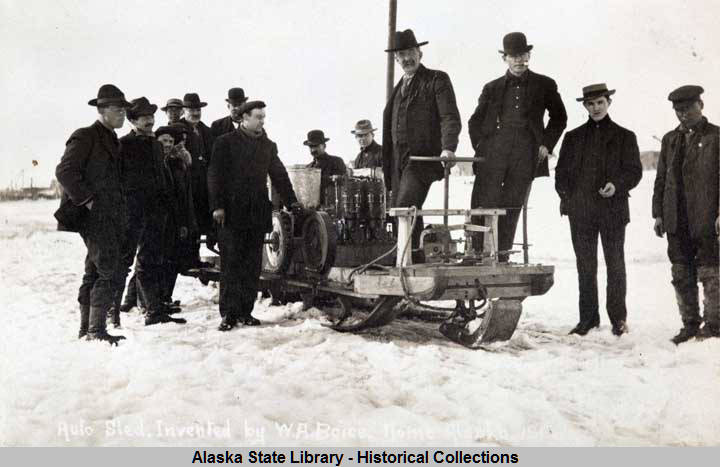
I have about 450 more photos to look through now, to see what I can cobble together. But before I go, one last picture: one of the first snowmobiles, built in Nome by W.A Boice. Who he was and if it worked? Seemingly lost to time.
 Northern Skies Publishing