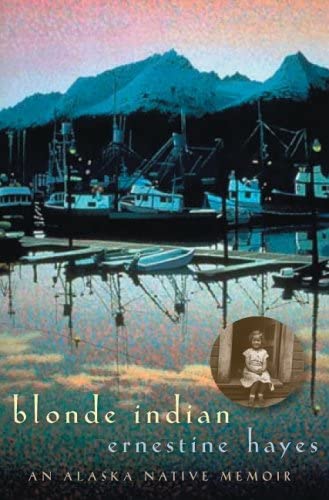
At the beginning of today’s writing session I was continuing to read “Blond Indian” by Ernestine Hayes. It’s not very helpful for my 1920s setting, but it’s giving me much better insight to the living conditions of Native Alaskans.
“Blond Indian” is literature with a capital L. It’s too heavy and abstract to be leisure reading. It reminds me of the novels I was assigned to read in undergrad: requires some thinking to appreciate.
The author was born in 1945, and it follows her life and that of another boy named Tawnewaysh. Tawnewaysh was renamed Tom when he was taken away to a boarding school. His native culture was punished right out of him, and he seems to become very submissive to the rules of white men. He went home to visit his family after a year of being away and experienced reverse culture shock, which strained his relationship with his family.
At the end of his visit home, his father spoke to him. Until this point he had been insisting that his name was now Tom; that it was the modern way to use English names; that it was best to listen to the white man’s guidance.
But then his father said something that made me literally drop my book: “Listen to me, Tawnewaysh. These white people kill something, and then they love it” (p 36).
The condemnation I feel, it’s like his father is standing there pointing his finger at me.
An animal becomes threatened/endangered, and we suddenly feel it is valued enough to save. A person of color is killed, and then we stand up for them. Even in religion, Jesus is killed and then we love him.
To borrow some wording from “Ishmael”, I can feel Mother Culture trying to sooth me. She whispers to me, “It’s not your fault. It’s just human nature, isn’t it? ‘Absence makes the heart grow fonder.’ ‘You never know what you have until it’s gone’. “
But are those human truths, or our cultural narrative?
I am wondering how our world would be different if being present and thankful were lifted up to the same extent as progress and capitalism? How would our narrative change, and would we have fewer regrets?
 Northern Skies Publishing