From the day I first started writing my Alaskan novel, I knew I wanted to make it historically accurate. It’s about a historic flight, set in 1920, so I needed to capture the period as best I could. You’ve heard a lot about that with posts on wood stoves, racism in Alaska, clothing, schools, and fishing. There is, however, another historical aspect I’ve been silently wrestling with: mom
The novel is from the perspective of a 16 year old girl who lives with her parents. While not the main character, the parents are integral to her daily life. So, how does she address her parents?
My gut reaction was that she should address them as “mother” and “father,” but that sounds so unnatural in it’s formality compared to the rest of the conversation. “Mom” and “Dad” are the contemporary norms. Writing against those norms is… well, weird. While I continue to use “mother” and “father,” I frequently argue with myself whether I should use forget historical accuracy in at least this instance for my audience. Not that they wouldn’t understand, but because they might find more enjoyment if the language is less stilted.
Edit: Upon more reflection, one of my grandmothers only used “mother” when talking about her parent, but used “mom” when referring to mine. She was born in 1927. My mom calls her mother “mom”, and my dad does too. But my dad… I’m not sure he used one more than another for his own mom.
Today I decided to call upon my academic training to help me decide once and for all. I don’t often have need to use my MA: English degree (no jokes about it’s usefulness, please) outside of, you know, my writing; so, this was fun.
Starting out I looked up “mom” and “dad” on etymonline.com, an etymology website that gives a rough timeline of a word’s roots and history. It says that “mom” was used in American English in 1867. That got me thinking that I’d have a good case to go ahead and use “mom.” But then things take a surprising turn.
I did an incredibly academic search of “mom v. mother” in Google (*said in sarcasm*), and found several sources that say “mom” was originally a term used in front of a slave’s name (Ex. mom Lewis). It was also used for slaves that had born a child, a nursing/nanny slave, and later, an honorific for a older black woman. Want to read more? Here is an easy-read source.
The picture I saw was that “mom” may have been used in 1867 in the United States, but had a different meaning than we might assume. How to know?
*Sound the trumpets!* Announcing, the BYU Corpus of Historical American English!
A corpus is a database of documents that are searchable by individual words. In their corpus a word can be searched singularly, compared to another, by part-of-speech, and with collocates. Collocates are the words that come directly before and after. For example, if you search the word “jump,” you’d find that it is commonly linked with “in” “off” or “around.” The corpus will also show you the text it came from, the year, and the actual sentence it was pulled from.
I entered “mom,” and it showed:

Compare that to “mother” and you’ll see a drastic difference in usage:
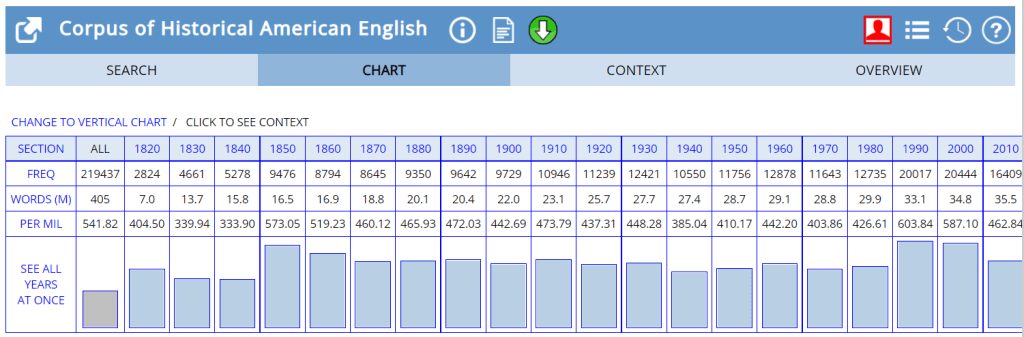
If you’re working from the corpus those dates and bar graphs can be clicked on to show more detailed data and specific usage. I did that. Why wouldn’t I? It’s not like I have a dozen+ chapters to edit…
The early usages of “mom” were indeed before names. Because we’re working with historical texts, quite a few usages were “moms” used alternative spelling for other words. While I can’t be 100% sure, it seemed to be used in place of “mum,” like “ma’am.” It wasn’t until into the 1900s that “mom” was used for “mother.”
You can see that “mother” has been consistently used more frequently than “mom.” I looked at the collocates for it, and it appears “mother” receives a large boost from biblical quotes. “Honor” and “thy” were huge collocates, along with “goose,” and more recently “day.”
There are plenty of details I’m leaving out, but I only have time to dig so long in this rabbit hole. One of the bigger flaws is that the corpus contains only written word, not spoken. “Mom” was likely used more in speaking than writing, which tends to be more formal. But, it’s not like there are many transcripts and recordings of spoken word from 1820-1900. So within availability limits and time constraints, as uncomfortably formal as it seems to contemporary me, I think “mother” remains the best choice.
Man does it feel good to geek out once in a while.
 Northern Skies Publishing